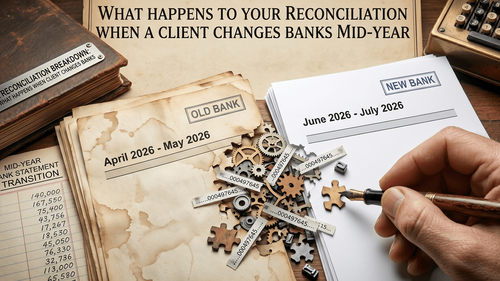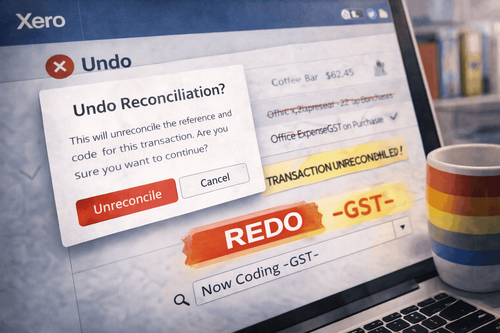

A bank reconciliation is the check that the balance in your books matches the balance on your bank statement. You tick off each transaction that appears in both places, then find and explain anything that does not. Until that is done, a profit figure or a BAS is only as good as the unmatched lines sitting underneath it.
It is not the same as double-entry bookkeeping, though it relies on it. Double-entry is how each transaction is recorded. Reconciliation is how you prove the bank account in those records is actually right.
The steps
- Get the bank statement (or feed) for the period, and the bank balance in your ledger at the same date.
- Tick off every transaction that appears in both places, for the same amount and date.
- List what is left: bank fees, interest, timing differences, duplicates, or payments that never made it into the books.
- Enter or adjust each difference, with a reason, or mark a timing item to clear in the next period.
- Confirm the adjusted book balance equals the statement balance.
If the two sides still do not agree, stop and find the line. Do not force a balancing journal just to make the report look tidy. A reconciliation that balanced yesterday can still be wrong today if a later feed, a duplicate or a recoded line has moved underneath it.
A simple example
Your ledger shows a bank balance of $12,450. The statement closes at $12,180. The $270 gap is not a mystery if you work through the unmatched lines:
- a $22 bank fee is on the statement, but not yet in the books
- a $248 supplier payment has cleared the bank, but was never coded in the ledger
Enter both, and the books come down to $12,180. That is a reconciled file. If instead you had a $248 deposit that the bank had not yet cleared, you would leave it as a timing item and keep it on the list until it appears.
Common gaps are quieter than people expect: a fee, a merchant settlement that arrives a day late, a duplicate after a CSV import, or a payment sitting in the wrong account. In Xero, a stuck or broken feed is another usual cause; what to do when Xero bank feeds stop syncing covers that case.
What this post is not
This is a method, not a review of your file. A company, trust or SMSF can have extra accounts and timing rules. If the difference will not resolve, a registered tax or BAS agent should look at it.
Ezyiah is a standalone Australian ledger that codes each line with a reason you can accept or change, at 95% first-pass accuracy on established accounts, and reconciles live bank feeds into those books. Business plans start from $79/mo, and firm plans start from $299/mo.
Last checked 26 November 2026.