
Short answer: Onboard a bookkeeping client in sequence: scope the catch-up, collect feeds and documents, agree a review date, and bring the file current before monthly work starts. The backlog blows out when those steps run in the wrong order, or when the quote assumes a clean file. Software can process history and live work together, but someone has to review exceptions.
Why does new-client onboarding create a backlog?
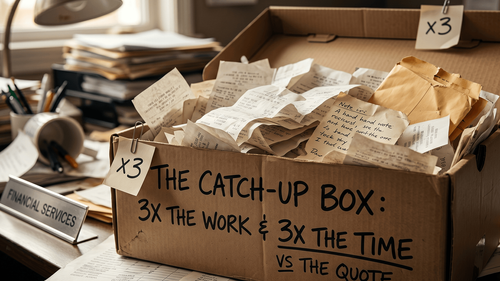
A new bookkeeping client rarely arrives current. There is usually a gap: months of unreconciled bank lines, missing invoices, a previous file that was not closed, or a BAS period that is already close. If you start the "ongoing" work on day one and treat the history as a side task, the catch-up sits behind every other deadline and then lands on the same people who are trying to lodge.
That is a process problem, not only a pricing problem. Why catch-up bookkeeping takes longer than you quote explains the hidden time inside the file. This article is about the order of work that stops that time from colliding with this month's books.
The blowout usually comes from one of four mistakes:
- the engagement is vague about how far back you will go
- documents and bank access arrive in dribs and drabs after you have already promised a date
- today's transactions and last year's backlog are mixed into one unsorted list
- review is left until the BAS is due, so exceptions become an emergency
What should you agree before you start?
Write the scope down before anyone logs in. At a minimum, agree:
- The catch-up period. Name the first date you will bring into the ledger, and the date you expect the file to be current. "We'll tidy up the past" is not a period.
- What "current" means. For most GST-registered clients it means the bank is reconciled to a stated date, GST coding has been reviewed, and the figures needed for the next BAS are ready for the person who will lodge.
- Who lodges. Bookkeeping, BAS preparation and BAS lodgement are different jobs. Confirm whether you, another registered agent, or the client will lodge, and who signs off the figures. For the legal line, see Can a bookkeeper lodge a BAS in Australia?.
- A review date that is earlier than the due date. Work backwards from the BAS due date, not forwards from the day the login arrives.
- What you are not doing. Opening balances, historical payroll, or a full year-end pack should be named if they are in or out. Do not assume they are included.
If the client cannot yet give you a complete set of records, shorten the promised catch-up or move the review date. Do not keep the original date and hope the documents appear.
What should you collect in the first week?
Collect access and evidence before you recode a single line. A practical first-week list is:
- Authority to act, and confirmation of who can approve coding and reports
- Bank feed connections, or statements in order, covering the whole catch-up period plus the current cycle
- The existing chart of accounts, or a clear decision to start from your standard Australian chart
- Opening balances at the start date, if you are moving from other software or a prior accountant
- Source documents for the exceptions you already know about: unpaid invoices, bills, receipts, loan statements, and any private-use notes
- BAS and instalment history for the periods you are taking on, so you do not relitigate amounts already lodged
If a document is missing, record that as an open item with an owner and a date, rather than parking it in a generic "client to send" pile. The file should show what is still outstanding.
Ezyiah can connect live bank feeds, accept PDF or CSV statements, and let a business owner and their accountant work in the same file through invites. It does not replace the need for opening balances, and purchase orders and supplier records are not live features.
How do you work the catch-up without pausing today's books?
Do the history, but do not stop the clock on new transactions.
Once the bank is connected, new lines will keep arriving. The efficient pattern is:
- bring the historical period into the ledger and work it as a defined job, with a start date, an end date and a reviewer
- let today's feeds continue in the same file, rather than holding them until the catch-up is "finished"
- review in batches: obvious patterns first, then exceptions, then anything that affects GST or the next BAS
- close each historical month or quarter when it is reviewed, so it cannot blend back into the current work
That is easier when historical processing and daily bookkeeping can run side by side. Ezyiah's changelog notes that years of backlog and daily bookkeeping can run together once live bank feeds are connected, with AI memory learning the client's coding patterns over time. Someone at the firm still has to review the exceptions. If seniors end up doing that review because the process is unclear, the cost shows up in the way described in The hidden cost of senior staff doing junior work.
Do not wait for a perfect document pack before you start the feeds. Start the feeds, list the missing evidence, and keep the catch-up moving against that list.
When is the file "current"?
Agree this in writing at the start, then test it at the review date. A useful definition, which you can adapt, is that the file is current when:
- every bank account in scope is reconciled to the agreed date
- income and expense coding for the catch-up period has been reviewed, and open exceptions are listed rather than hidden
- GST treatment for the next BAS period is ready for the person who will lodge
- the profit and loss and, where you produce them, the balance sheet for the period can be generated from the same ledger
- the client has confirmed any private-use, loan or director items you flagged
"Current" is not the same as "every historical receipt has been found". If a document is still missing after the agreed date, either park that item as an explicit exception or change the scope. Leaving it unnamed is how the backlog returns the following month.
A simple onboarding sequence
Use this as the working order, not as a script you must follow word for word:
- Scope and dates. Confirm the catch-up window, the meaning of "current", who lodges, and the review date.
- Access and documents. Connect banks, collect statements, opening balances and the known source documents in the first week.
- Open the ledger. Set the chart of accounts and opening balances so new work has somewhere to land.
- Process the catch-up. Code and reconcile the historical period as a closed job, in date order.
- Keep the live feed going. Review new transactions on their own cycle so they do not queue behind the history.
- Review before the due date. A person signs off exceptions, GST and the reports, early enough to fix issues.
- Hand into the monthly rhythm. Only then treat the client as "business as usual", with a recurring review each cycle.
The sequence is what prevents a backlog blowout. Tools change how quickly steps 4 and 5 run; they do not remove steps 1, 6 or 7.
Where does an AI bookkeeper help — and where does it not?
An AI bookkeeper can take a large part of the recording work: it pulls bank transactions into its own ledger, proposes coding and GST treatment, matches receipts and invoices, and produces a P&L and BAS figures from the reconciled data. That is useful on a new file because the volume is usually in the bank lines, not in the judgement calls.
It does not onboard the client for you. It does not chase a missing loan statement, decide whether a worker is a contractor, or lodge the BAS. Ezyiah is an AI bookkeeper that runs its own ledger rather than sitting in front of Xero or MYOB. Firms use it to process the backlog and the live feed in one place, then review before lodgement. It does not run payroll, and it does not replace the engagement letter or the review date.
For how this sits in a firm workflow, see accounting firms.
FAQ
How long should bookkeeping client onboarding take?
It depends on the catch-up period, the quality of the records, and how quickly the client provides access. Agree a review date from the scope, not from a generic number of days. If the documents are incomplete, move the date rather than pretending the original one still holds.
Should I finish the catch-up before I connect the live bank feed?
Usually no. Connect the feed so new transactions do not pile up uncoded while you work through the history. Keep the historical period as a separate, closable job inside the same file.
What if the previous accountant will not release the file?
Scope the work from the bank records and documents you can get, set opening balances as best as the evidence allows, and record what you could not verify. Do not promise a complete historical reconstruction you cannot support.
Can software onboard the client automatically?
Software can connect feeds, process historical and live transactions, and prepare reports. It cannot agree the scope, collect missing documents, or take responsibility for lodgement. Those steps still need a person.
Who should review the first BAS on a new file?
The person who is responsible for the lodgement, with enough time before the due date to fix exceptions. Do not leave the first review until the day the BAS is due.
Start the catch-up and the live books together
Ezyiah connects to the client's bank, codes transactions and GST, matches receipts and invoices, and lets historical backlog and daily bookkeeping run in the same ledger. Your team reviews exceptions and approves the BAS figures before lodgement. Plans start from $79/mo for businesses, $299/mo for firms, GST-inclusive. Ezyiah is trusted by 4,000+, with 95% first-pass accuracy, and the subscription is 100% tax deductible. See how Ezyiah works for accounting firms, or start your free trial.
This article is general information, not tax or accounting advice. Check your own situation, and your client's, with a registered tax or BAS agent.
Sources
- Ezyiah, Why catch-up bookkeeping takes longer than you quote, accessed 11 November 2026
- Ezyiah, The hidden cost of senior staff doing junior work, accessed 11 November 2026
- Ezyiah, Can a bookkeeper lodge a BAS in Australia?, accessed 11 November 2026
- Ezyiah, BAS due dates, accessed 11 November 2026
- Ezyiah, What is an AI bookkeeper?, accessed 11 November 2026
- Ezyiah, Changelog (live bank feeds; backlog and daily bookkeeping side by side; AI memory; invites; PDF statement upload), accessed 11 November 2026
- Ezyiah, Pricing and pricing for businesses, accessed 11 November 2026