

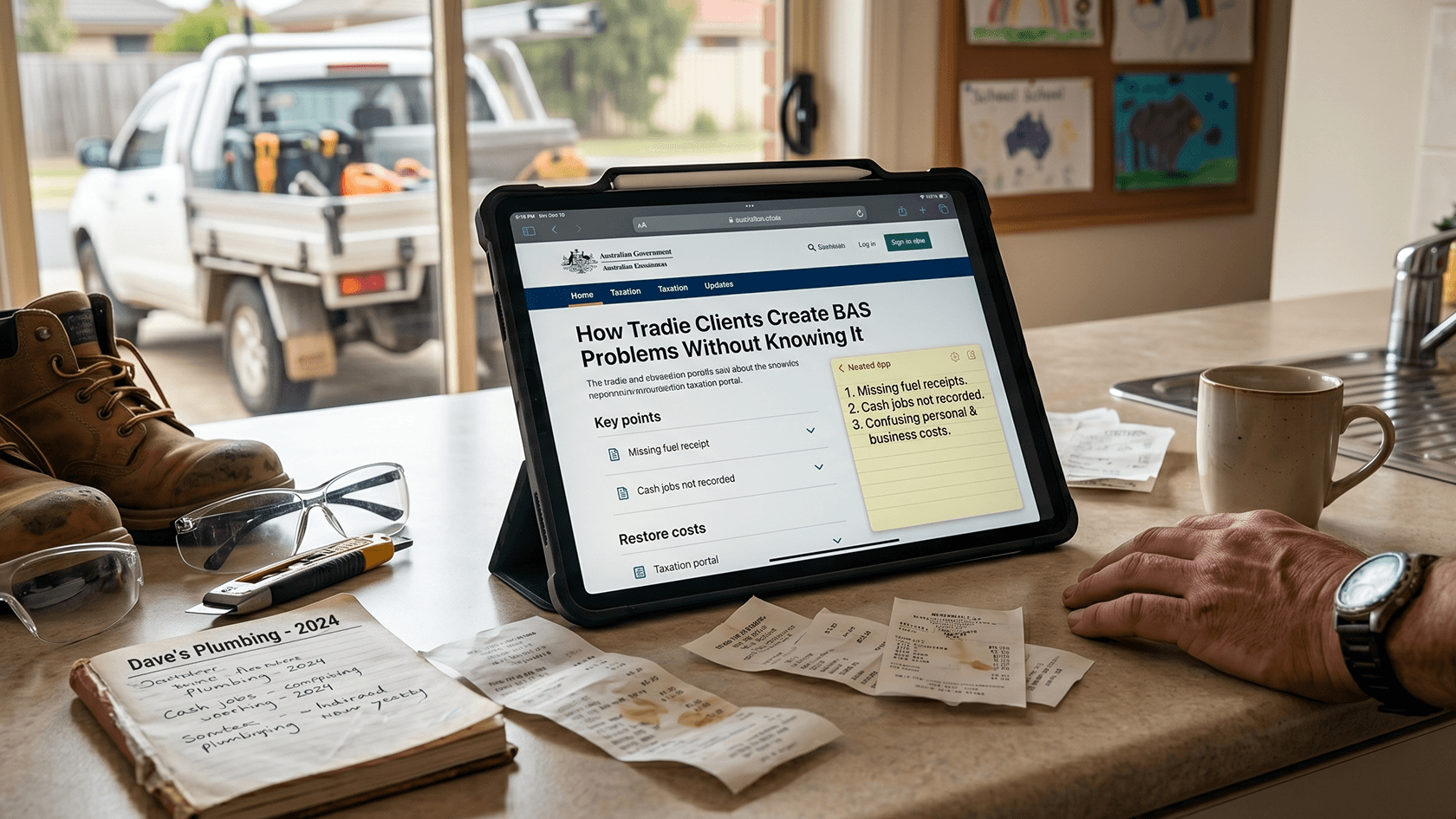
It is never deliberate. A plumber running three jobs a day, quoting a fourth, and ordering materials on the weekend is not thinking about GST coding when they swipe the card. But when the quarter closes, the file tells a different story: personal purchases mixed into the business account, tools bought on finance where the GST was claimed but the asset never made the register, cash income that came through a mate's account and never hit the books. Tradie clients do not create BAS problems on purpose, they create them because the work is physical, fast, and done by people who are not thinking about tax codes while they are on the tools. The good news is that the errors are predictable, which means they are preventable.
The errors that show up in almost every tradie file
The same handful recur: mixing personal and business accounts, failing to charge GST once turnover crosses the registration threshold, claiming GST on wages and super which carry none, mishandling plant and equipment bought under finance, not recording cash income, and applying a made-up business-use percentage to a vehicle used for both work and private trips. None are exotic, and every one is avoidable with the right setup at onboarding. The vehicle issue deserves specific attention because it hides a defensibility trap. A commercial vehicle with a load capacity over one tonne is not subject to the car limit, which changes how it can be depreciated or written off. But whether an immediate write-off is available at all, and up to what value, depends on the instant asset write-off threshold for the relevant income year, and that threshold has changed repeatedly and is set by legislation that is not always settled in advance. So the rule to give staff is not a dollar figure, it is a process: check the current threshold and its legislative status on the ATO site for the year in question before promising a client anything. And when the vehicle has mixed use with no logbook, the business-use percentage the client gives you is a guess, and claiming against a guess is a problem waiting to surface under review.
The threshold issue catches more tradies than it should, and here the mechanic matters more than the number. GST registration is compulsory once annual turnover reaches the registration threshold, and the obligation to charge GST starts from the date registration was required, not the date the client got around to registering. A tradie who crosses the threshold in one quarter but registers two quarters later has been undercharging GST the whole time, and the liability does not disappear. It comes out of their margin instead of being collected from customers, which is a genuinely expensive surprise. Equipment bought under chattel mortgage adds a second layer that spans two obligations at once: for a GST-registered business the full GST credit on the purchase can generally be claimed on the next BAS, while the income tax deduction is worked out on the GST-exclusive cost. Code the asset at the wrong value, or claim the GST credit twice, once through the BAS and again inside the write-off calculation, and you get an error that touches both GST and income tax and takes longer to untangle than either alone.
Why cash income belongs on every quarterly checklist
Cash income is the hardest to verify and the most worth asking about, precisely because it never shows up in the bank feed to prompt anyone. Tradies who do cash jobs, especially small residential work, sometimes leave it out simply because it did not pass through the business account. That income is still assessable, and it still counts toward the GST turnover figure that decides registration. The practical tell is a mismatch between the volume of work a client describes and what the feed actually shows, and that mismatch is a reasonable, non-accusatory prompt to ask the question at the quarterly review rather than discovering it later. Raising it as routine process, something you ask every tradie client, keeps it from feeling like an accusation and makes it far more likely you get a straight answer.
The fix is at onboarding, not at lodgement
All of these are cheaper to prevent than to unwind, and they are prevented in the same place: onboarding. Separate business and personal accounts so the mixing never starts. A clear process for capturing receipts and invoices so the paper trail exists before it is needed. A logbook for any vehicle with mixed use so the business-use percentage is evidenced rather than guessed. And a standing quarterly check on turnover against the GST registration threshold, so the client registers on time instead of eating months of uncharged GST. Firms that build a tradie-specific review into the quarterly workflow catch these errors while they are small, rather than spending BAS week untangling a file that never had the right structure to begin with. The heavy lifting done once at the start is what turns a chaotic tradie file into a predictable one.