

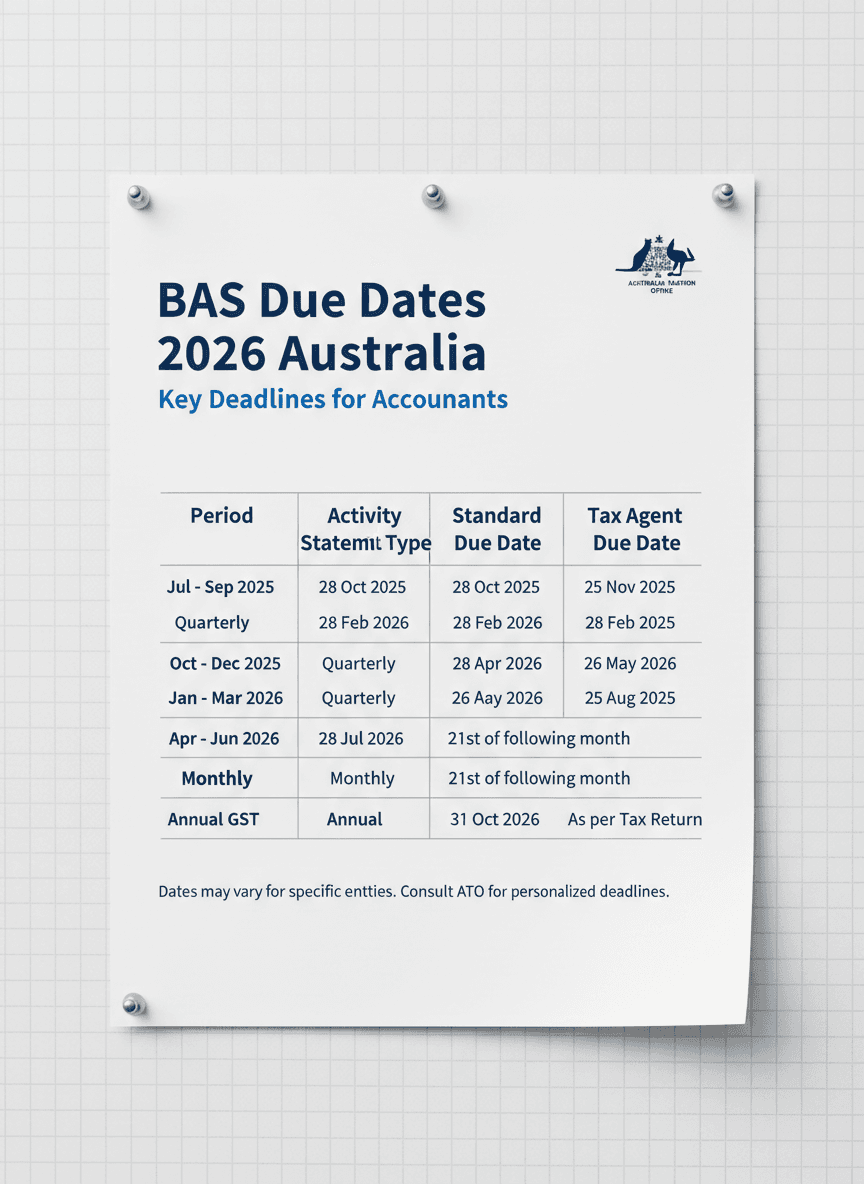
If you are searching "BAS due dates 2026 Australia," you are almost certainly building a lodgement schedule or a compliance calendar. The ATO sets standard quarterly and monthly deadlines, but for a firm the standard dates are only half the story, because most of your clients lodge through the agent program and get more time. Here are both. For self-lodgers, the quarterly BAS due dates run 28 February 2026 for the October to December 2025 quarter, 28 April 2026 for January to March, 28 July 2026 for April to June, and 28 October 2026 for the July to September 2026 quarter. Monthly BAS is due on the 21st of the following month. If a due date lands on a weekend or public holiday, it moves to the next business day.
The agent concession dates your firm actually works to
This is the part a firm needs, and the part generic due-date lists usually leave out. When you lodge electronically through the registered agent lodgement program, three of the four quarters get roughly four extra weeks. For the 2025-26 year the agent concession dates are 26 May 2026 for the January to March quarter and 25 August 2026 for the April to June quarter, with the July to September 2026 quarter's concession falling in late November 2026. The exception is the October to December quarter, which has no separate agent concession because its 28 February date already builds in the Christmas and New Year break. Two conditions attach to the concession: the BAS must be lodged electronically by the registered agent, and the client's previous BAS must also have been lodged electronically. If it is the client's first statement, or the prior one went in on paper, the concession may not apply and the standard date stands. Monthly lodgers get no agent concession either, apart from the December monthly period. Because these program dates shift year to year and depend on the client's history, the reliable source is always the due date shown against each client in Online services for agents, not a fixed list.
Why the date is the easy part
The deadline itself is predictable. The pressure around it is not, and that is what actually determines how the last week goes. The real squeeze comes from volume and timing colliding, because when a batch of quarterly clients all fall due on the same date, even a small reconciliation issue or a bit of GST coding drift turns into a bottleneck across the whole book. Public holidays, bank feed disruptions, and clients who send their records late all compress the genuine working window well inside the official one. If transactions are imported late, if duplicates appear after a CSV upload, or if GST treatment has drifted during the quarter, the final week before the due date becomes reactive instead of controlled. That is why firms look up BAS deadlines not just to know the date, but to work backwards from it and protect enough review time to hit it calmly.
How to stay ahead of the 2026 deadlines
Track both sets of dates, the self-lodger deadlines and the agent concession dates, and confirm which applies to each client rather than assuming the concession is automatic, because the electronic-lodgement conditions catch firms out every year. Then do the thing the dates themselves cannot do for you, which is review files early in the reporting period instead of waiting for the final week. Deadlines do not create BAS errors. Compressed review time does, by forcing rushed coding and skipped checks right when accuracy matters most. The earlier reconciliation and GST consistency are reviewed across the quarter, the less the due date matters, because the file is already ready when it arrives. Knowing the 2026 dates keeps you compliant. Working back from them, with room to review, is what keeps lodgement calm.