

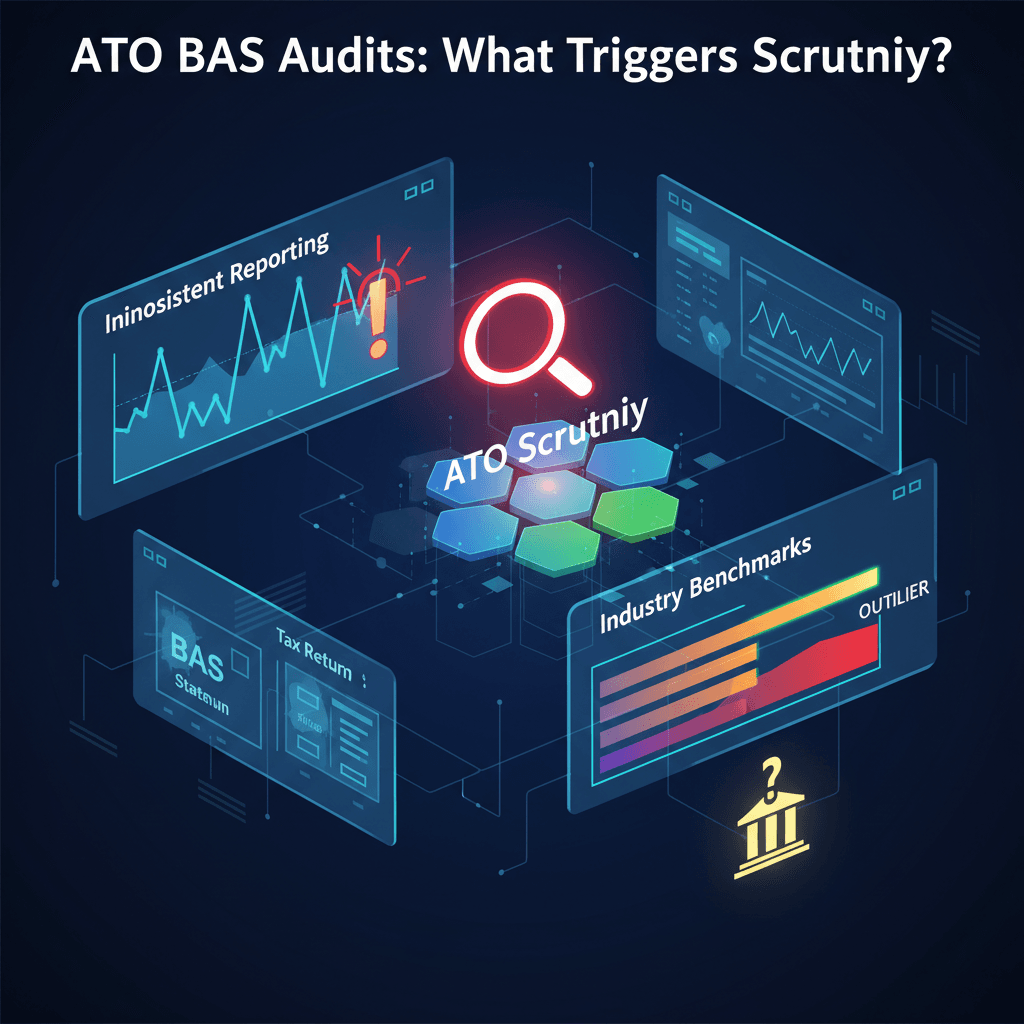
When someone searches "ATO BAS audit triggers," they usually want to know whether something specific set the review off. The reassuring and slightly unnerving answer is that ATO scrutiny is rarely random, and rarely about a single number. It is pattern-based. The ATO runs extensive data matching across GST reporting, PAYG withholding, income tax returns, and industry benchmarks, and what draws attention is not one mistake but a set of figures that do not reconcile with each other or with what a business like this one would normally report. Understanding that shifts the whole question. The goal is not to avoid ever making an error. It is to make sure your reporting makes sense over time and holds together across the different places the same business shows up in the ATO's data.
What actually draws attention
The clearest flag is a significant movement in GST on sales or GST on purchases with no obvious business reason. A sharp jump or drop in one quarter against the prior pattern invites the question of why, and if there is no ready explanation, that question can become a review. Repeated BAS amendments are another. An occasional correction is normal and expected, but the same periods being revised quarter after quarter reads as a process problem rather than a one-off, and it suggests the underlying data was never fixed, only patched. The areas the ATO already watches closely amplify this: fuel tax credits, GST on imports, and private-use adjustments all attract scrutiny when they are claimed inconsistently or appear unusually high relative to turnover, because those are the categories where errors and overclaims cluster.
What ties these together is that most of them trace back to exactly the transaction-level problems that quietly distort a BAS. Duplicate transactions from a CSV import inflate figures. A misclassified director loan puts GST where none belongs. GST coding drift over a quarter makes similar transactions look inconsistent. Each of those was a small issue at the transaction layer, and each one surfaces here, at the point where the BAS no longer lines up with the income tax return or the industry benchmark. The ATO is not looking for perfection, and it knows businesses vary. It is looking for the mismatch that has no story behind it, the figure that cannot be reconciled with the rest of what the business has reported.
Why "explainable" matters more than "correct"
This is the distinction worth internalising. A review is far less about whether every number is flawless and far more about whether the numbers make sense together and can be explained. A large movement with a clear, documented reason is not a problem, even if it is unusual, because the moment the ATO asks, there is an answer. The same movement with no supporting records is where the stress lives, because now the business is reconstructing a justification after the fact, under scrutiny, often without the context that made the original decision reasonable. This is why clean transaction data and proper linkage matter so much for audit exposure. They are not just good bookkeeping, they are the difference between a review that resolves in one exchange and one that expands.
The practical protection follows directly. Keep GST coding consistent across the period so similar transactions stay similar. Avoid repeated amendments by fixing the root cause the first time rather than patching the symptom. And make sure any large or unusual movement in the BAS is documented and explainable while the context is still fresh, not left to be rebuilt when a reviewer asks about it a year later. Most BAS reviews are not about one bad number. They are about whether a business's reporting is coherent over time, and a firm that keeps its transaction layer clean and its unusual movements explained turns an audit from a scramble into a formality.