

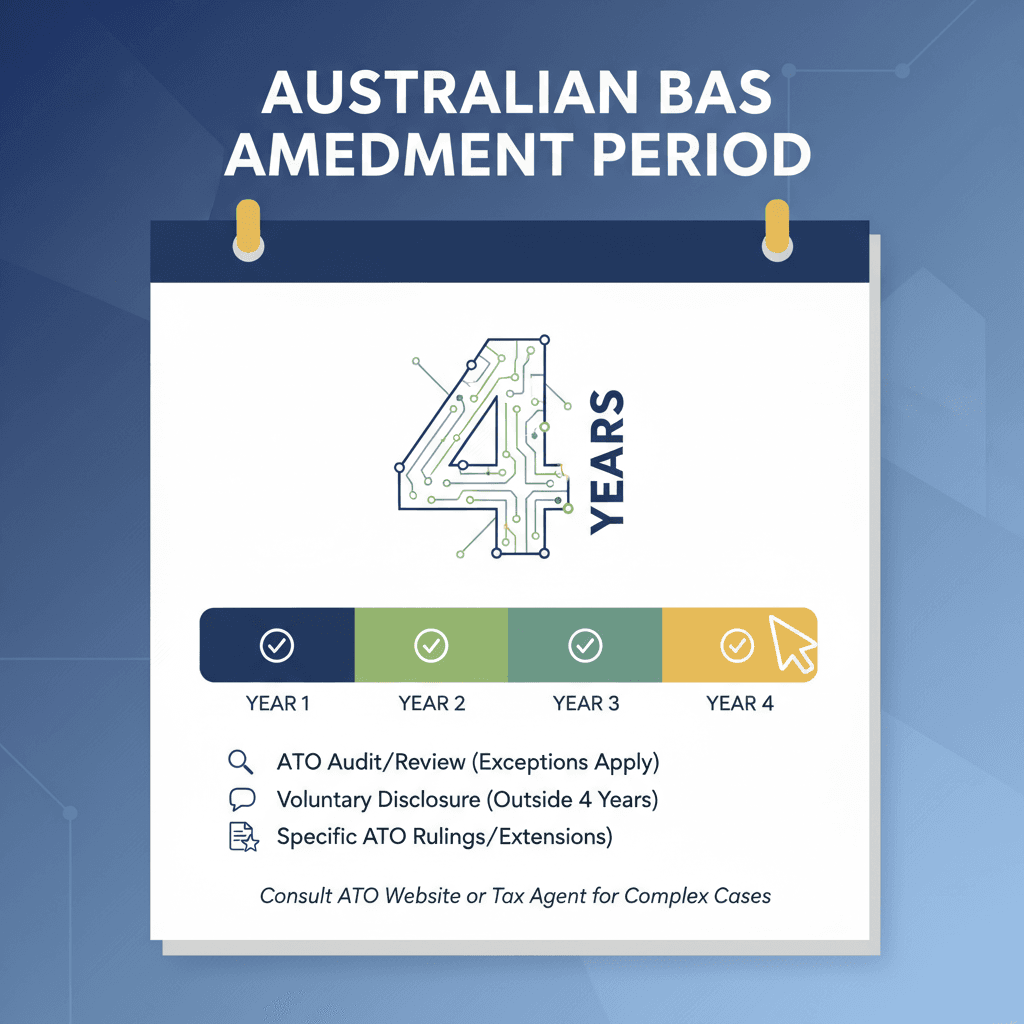
When a mistake surfaces on a BAS you lodged months or even years ago, the first question is not usually whether to fix it, it is whether you still can. And the honest answer is that it depends on which four-year clock you are looking at, because a BAS does not have one deadline, it has several, and they do not all run out at the same time or mean the same thing. Most people assume there is a single "four years to amend a BAS" rule. There is not, and treating it as one is how firms either miss a window that was still open or assume one exists when it has already closed. The starting point is the period of review, which is generally four years from the day after your assessment, and for most BAS that is the day you lodged. Inside that window the ATO can amend your assessment for overpaid or underpaid GST. Outside it, they generally cannot, except in limited circumstances. But the period of review is only the first clock, and for the errors firms most often need to fix, it is not the one that binds.
The three clocks that actually decide it
The first thing that changes the answer is what kind of error it is. A credit error, where you reported or paid too much GST, can be corrected on a later BAS as long as that later BAS is lodged within the four-year period of review for the original period, and credit errors carry no value limit. A debit error, where you reported or paid too little, is stricter: it can only be corrected on a later BAS if it falls within both a time limit and a value limit that scale with your current GST turnover, and if it exceeds either, you cannot roll it forward at all. You have to revise the original period it was made in. So "how long do I have" already splits in two before you have looked at a date, because the same age of error is correctable one way and not the other depending on its direction.
The second, and the one that catches firms out most, is the separate four-year credit time limit that applies to unclaimed GST credits and fuel tax credits. This clock is not the same as the period of review, and it is far less forgiving. It runs generally four years from the due date of the earliest BAS in which you could have claimed the credit, and here is the trap: lodging an amendment request or a revised BAS does not stop this clock. The credit is only preserved once the ATO has actually processed the amendment and included it in your assessment. So if a client is sitting on unclaimed credits from a period nearing its limit, the entitlement can expire in the gap between you lodging the request and the ATO processing it, even though the period of review is still open and even though you lodged in time. Once those credits expire, the ATO has no discretion to bring them back. This is the single most expensive misunderstanding on this topic, because it costs a client real money that was rightfully theirs.
How to work out whether you still have time
Start by naming the error, because the classification decides the clock. If it is a credit error inside the four-year period of review, you can generally correct it on your next BAS. If it is a debit error, check it against the current time and value limits for the client's turnover before assuming you can roll it forward, because above those limits the law requires you to revise the original period, and revising may attract a general interest charge on the amount that was underpaid. If it involves unclaimed GST or fuel tax credits, treat the four-year credit time limit as the real deadline and give yourself a buffer, because processing time counts against you, not for you. A few things can quietly shut a window early regardless of the dates: an error caused by recklessness or intentional disregard cannot be rolled into a later BAS at all, and a period already under ATO review or audit is generally off-limits for self-correction until they clear it. Because the specific value limits and turnover bands are set by legislative instrument and can change, do not work from a figure you memorised. Confirm the current limits for the client's turnover against the ATO's correcting GST errors guidance, and check the actual assessment date rather than assuming it matches the lodgement date. The deadline to amend a BAS is real, but it was never a single four-year line. It is a set of them, and knowing which one applies to the error in front of you is the whole answer.